



Private Synthetic Monitoring Zones (STM Zones) are now available in Centreon Experience Monitoring, to monitor your internal applications.
What it means
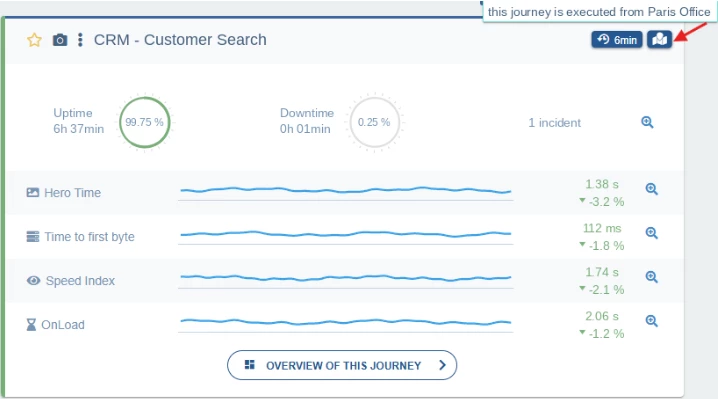
A private STM Zone allows you to monitor your user journeys on internal domains or networks specific to your organization, using a probe deployed inside your infrastructure.
Your internal applications are no longer out of reach: CRM, back-office, intranet, business portals, ERP... You can now run user journeys on them.
How it works
The probe is created and launched on a machine inside your infrastructure with the Docker commands provided in Centreon Experience Monitoring. You can then analyze your internal journey just like a regular user journey.
Two types of probes are available:
-
STM probe: collects the usual performance and availability metrics used by Experience Monitoring.
-
Recommendations probe: provides personalized recommendations to optimize your applications.
Monitor from several locations
You can create several STM Zones, for example one per data center or office, and use them to run a user journey from multiple locations. Give each zone a meaningful name (e.g. Paris Office) to tell them apart.
Getting started
Create a new Synthetic Monitoring Zone, obtain a probe token, associate a probe and run the Docker commands provided, then associate the zone with your user journey.
Prerequisites: a machine inside your infrastructure able to access the application to monitor, and a user journey configured on that application.
We would love your feedback in the comments.
Want to go further? Read our blog post to see how private STM Zones bring synthetic monitoring to your internal applications, without opening inbound ports or exposing them to the internet: Synthetic Monitoring for Internal Applications